
- Admin
- 0 Comments

How to Select the Right Rebar Coupler for Your Project?
Choosing the right rebar coupler is an important decision in reinforced concrete construction. As modern buildings and infrastructure projects use larger reinforcement bars and more complex reinforcement arrangements, traditional lap splicing can create challenges such as reinforcement congestion, additional steel consumption, limited working space, and difficult installation.
A mechanical rebar coupler provides an alternative method for connecting reinforcement bars end-to-end. However, not every coupler is suitable for every project. The correct selection depends on factors such as rebar diameter, steel grade, structural requirements, connection type, installation conditions, applicable standards, and project environment.
Whether you are working on a high-rise building, bridge, metro project, tunnel, railway, dam, power plant, airport, or industrial structure, understanding how to select the right rebar coupler can help ensure an efficient and reliable reinforcement connection system.
What Is a Rebar Coupler?
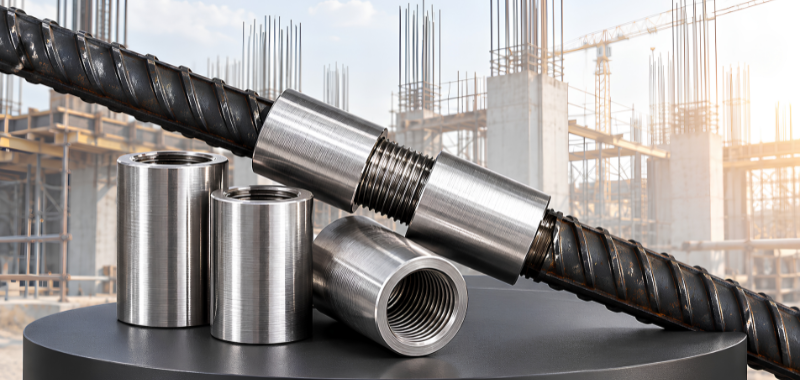
A rebar coupler is a mechanical connector that joins two reinforcement bars. It connects rebars without relying on the conventional overlapping arrangement of a lap splice.
Mechanical splicing systems are available in different designs and installation methods. Depending on the project requirements, these may include threaded couplers, cold forged parallel thread couplers, crimping or sleeve couplers, weldable couplers, reducer couplers, and headed or terminator couplers.
The selected mechanical rebar coupler should be compatible with the reinforcement bars and capable of meeting the structural and project-specific requirements.
Why Is Choosing the Right Rebar Coupler Important?
The coupler is an important component of the reinforcement connection. Selecting an unsuitable product can create installation difficulties or prevent the connection from meeting the required design specifications.
The right rebar coupler can help construction teams:
- Create efficient reinforcement connections
- Reduce reinforcement congestion
- Minimize unnecessary lap lengths
- Optimize steel consumption
- Improve reinforcement installation
- Address space limitations
- Connect large-diameter reinforcement bars
- Support demanding infrastructure applications
- Maintain consistency in reinforcement connections
The selection should always be based on engineering requirements rather than simply choosing a coupler based on availability or cost.
7 Factors to Consider When Selecting a Rebar Coupler
1. Check the Rebar Diameter
The first factor to consider when selecting a rebar coupler is the diameter of the reinforcement bar.
Reinforcement bars are available in different diameters, and couplers are manufactured for specific bar sizes or ranges. Before ordering, confirm the exact diameter of the reinforcement bars that need to be connected.
For example, a coupler designed for a particular bar diameter should not be assumed to be suitable for another diameter without confirmation from the manufacturer or project specifications.
Always check:
Rebar diameter
Coupler size
Compatible bar range
Thread or connection dimensions
Manufacturer specifications
For projects involving multiple rebar diameters, reducer or transition couplers may be considered where approved by the structural design.
2. Consider the Rebar Grade and Material
The reinforcement steel grade is another important consideration.
A mechanical rebar coupler must be suitable for the reinforcement steel being used on the project. The mechanical properties of the reinforcement and the required performance of the connection should be reviewed before selecting the product.
Before finalizing a coupler, verify:
Rebar grade
Tensile strength requirements
Yield strength requirements
Coupler material
Compatibility with the reinforcement steel
Required test documentation
This is particularly important for major infrastructure and structural projects where reinforcement connections are required to meet defined performance criteria.
3. Understand the Required Connection Type
Different construction conditions may require different types of mechanical splicing systems.
Some commonly used rebar coupler types include:
Parallel Thread Couplers
Parallel thread couplers use a threaded connection between reinforcement bars and the coupler. They are commonly considered where a threaded mechanical connection is required.
Cold Forged Parallel Thread Couplers
Cold forged parallel thread couplers are manufactured using a cold-forging process and parallel threading system. They can be selected for projects requiring a mechanical threaded connection.
H Type Couplers
H Type couplers are designed for specific reinforcement connection arrangements and can be considered where standard coupling configurations may not be suitable.
Weldable Rebar Couplers
Weldable couplers can be used where reinforcement needs to be connected to structural steel components or other elements through an approved welding process.
Stainless Steel Couplers
Stainless steel rebar couplers may be considered for applications where corrosion resistance is an important requirement.
Reducer or Transition Couplers
When two reinforcement bars with different diameters need to be connected, reducer or transition couplers may provide a suitable solution.
Terminator and Headed Bar Couplers
These systems are designed for applications involving reinforcement anchorage and termination requirements.
Crimping or Sleeve Couplers
Crimping and sleeve-type systems use mechanical deformation or sleeve-based connection methods to join reinforcement bars.
The appropriate type should be selected according to the structural design, installation conditions, bar configuration, and applicable standards.
4. Evaluate the Structural Load Requirements
A critical factor when selecting a rebar coupler is the load requirement of the structural connection.
Different applications may require connections capable of handling tension, compression, or both. The required performance should therefore be determined by the structural engineer and matched with the technical specifications of the selected coupler.
Consider:
Required tensile performance
Compression requirements
Cyclic or fatigue loading where applicable
Seismic requirements where applicable
Structural member requirements
Applicable design codes and project specifications
Do not select a coupler solely based on its physical size. Its tested and specified performance must match the project’s engineering requirements.
5. Consider Reinforcement Congestion
Reinforcement congestion is a common challenge in heavily reinforced columns, beams, walls, foundations, and structural joints.
Traditional lap splicing can require additional reinforcement length and create overlapping bars within the same area.
A mechanical rebar coupler connects reinforcement bars end-to-end, which can reduce the reinforcement overlap associated with conventional lap splicing.
This can be particularly useful in:
Heavily reinforced columns
Shear walls
Foundations
Bridge structures
Metro structures
Tunnel sections
Transfer beams
Large concrete structures
Before selecting the coupler, review the reinforcement drawings and identify areas where congestion or limited space could affect installation.
6. Check Installation Conditions
The best rebar coupler for a project is also dependent on site conditions.
Consider how the coupler will be installed and whether workers have sufficient access to complete the connection correctly.
Important questions include:
Is there sufficient working space?
Can the required equipment reach the reinforcement?
Is the connection accessible from one or both sides?
Does the project require pre-fabricated reinforcement?
Is on-site threading required?
Are special tools required?
What installation time is available?
For projects with restricted access, such as tunnels, underground structures, and congested reinforcement zones, installation requirements should be evaluated before selecting the coupling system.
7. Verify Standards, Testing and Quality Requirements
Quality assurance is one of the most important aspects of rebar coupler selection.
Before approving a mechanical splicing system, check the applicable standards and project specifications. Depending on the location and project, requirements may include national standards, international standards, third-party testing, inspection procedures, and project-specific approvals.
Ask the manufacturer for relevant technical documentation, such as:
Product specifications
Material information
Test reports
Quality certificates
Installation instructions
Dimensional details
Applicable standard compliance
Inspection and quality-control documentation
SPPLICETEK states that its rebar coupler manufacturing follows quality-control processes and lists ISO 9001 certification and compliance with IS 16172:2014 among its credentials.
Rebar Coupler Selection Based on Project Type
Different projects may have different reinforcement connection requirements.
Project Type | Important Considerations |
High-Rise Buildings | Reinforcement congestion, large-diameter bars, installation space |
Bridges | Structural loading, durability, reinforcement continuity |
Metro Projects | Restricted spaces, repetitive connections, installation efficiency |
Tunnels | Limited access, reinforcement congestion, site conditions |
Dams | Large reinforcement quantities, structural requirements |
Power Plants | Heavy reinforcement and project-specific specifications |
Airports | Large structural elements and reinforcement arrangements |
Industrial Buildings | Construction speed, reinforcement configuration |
Railway Projects | Structural requirements and connection performance |
Heavy Civil Infrastructure | Bar diameter, load requirements, installation conditions |
The table provides general considerations; the final coupler selection should be based on the approved engineering design and project specifications.
How to Select the Right Rebar Coupler: A Simple Checklist
Before placing an order, project teams can use the following checklist:
Step 1: Identify the Rebar Diameter
Determine the exact diameter of the bars that need to be connected.
Step 2: Confirm the Rebar Grade
Check the reinforcement steel grade and mechanical properties.
Step 3: Define the Connection Requirement
Determine whether you need a standard coupler, reducer coupler, weldable coupler, headed connection, or another mechanical splicing solution.
Step 4: Review Structural Requirements
Confirm the required tensile, compression, fatigue, seismic, or other performance requirements where applicable.
Step 5: Assess Site Conditions
Consider accessibility, available space, installation equipment, and working conditions.
Step 6: Check Applicable Standards
Verify that the selected rebar coupler meets the relevant project standards and specifications.
Step 7: Review Testing and Certification
Request appropriate test reports, certificates, and technical documentation from the manufacturer.
Step 8: Confirm Installation Procedure
Make sure the site team understands the manufacturer’s installation requirements and has the necessary tools and equipment.
Why Choose the Right Rebar Coupler Manufacturer?
The quality of the mechanical splicing system is closely connected to manufacturing consistency, product design, testing, and technical support.
When evaluating a rebar coupler manufacturer, consider:
- Product range
- Manufacturing capabilities
- Quality-control systems
- Testing facilities
- Certifications
- Technical documentation
- Installation support
- Availability of different coupler types
- Experience with infrastructure applications
A manufacturer with a broad product range can also make it easier to select different coupler configurations for different reinforcement requirements within the same project.
SPPLICETEK Rebar Coupler Solutions
SPPLICETEK provides mechanical rebar couplers and mechanical splicing solutions designed for different reinforcement connection requirements in construction and infrastructure projects.
Its rebar coupler range includes:
- Cold Forged Parallel Thread Couplers (CFPTC)
- Parallel Rebar H Type Coupler
- Weldable Rebar Coupler
- Parallel Rebar S.S. Coupler
- Terminator / Headed Bar Coupler
- Reducers / Transition Coupler (H-Type Reducer)
- Crimping / Sleeve Coupler
These rebar coupler solutions are designed for different reinforcement configurations, bar sizes, connection requirements, and project conditions. They can be used across SPPLICETEK’s building and infrastructure applications, including Bridges, Hydro Power, Railway, Underground Metro, Metro, Bullet Trains, Nuclear Power Plants, and Airports.
Whether the project requires threaded connections, transition between different rebar diameters, specialized anchoring, weldable connections, or sleeve-based mechanical splicing, SPPLICETEK offers different rebar coupler types to address specific reinforcement connection requirements.
Frequently Asked Questions About Rebar Couplers
-
What factors should I consider when selecting a rebar coupler?Important factors include rebar diameter, steel grade, structural load requirements, connection type, installation conditions, applicable standards, testing, certification, and project specifications.
-
Which rebar coupler is suitable for large-diameter reinforcement bars?The suitable coupler depends on the bar diameter, steel grade, structural requirements, and manufacturer's approved product range. Heavy-duty or appropriately rated mechanical couplers may be considered for large-diameter reinforcement.
-
Are all rebar couplers suitable for every type of reinforcement bar?No. Couplers are designed for specific bar sizes, grades, connection configurations, and installation methods. Compatibility should always be confirmed before selection.
-
Can rebar couplers reduce reinforcement congestion?Mechanical couplers can reduce the overlapping reinforcement associated with conventional lap splicing. This can help create more space in heavily reinforced structural sections.
-
How do I know if a mechanical rebar coupler meets project requirements?Review the manufacturer's technical specifications, test reports, certificates, applicable standards, and installation requirements. The product should also be approved according to the project's structural design and specifications.
-
Can one project use different types of rebar couplers?Yes. Large construction projects may require different coupler types depending on reinforcement diameter, connection location, accessibility, anchorage requirements, or other project conditions. Each application should be evaluated separately.
Conclusion
Selecting the right rebar coupler is not simply about choosing a connector that fits the reinforcement bar. The correct selection requires consideration of rebar diameter, steel grade, structural loading, connection type, reinforcement congestion, site accessibility, installation requirements, applicable standards, and quality documentation.
A properly selected mechanical rebar coupler can provide an efficient reinforcement connection solution for demanding construction and infrastructure applications. By evaluating project requirements carefully and working with a qualified rebar coupler manufacturer, engineers, contractors, and procurement teams can select a coupling system that aligns with their structural and construction needs.
Looking for a suitable rebar coupler for your construction project? Explore the mechanical splicing solutions from SPPLICETEK and discuss your reinforcement requirements with the technical team.