
- Admin
- 0 Comments

Why Use Rebar Couplers in Your Construction Projects?
Modern construction projects demand reinforcement systems that can deliver structural reliability, construction efficiency, and better utilization of materials. As buildings and infrastructure projects become larger and more complex, traditional methods of joining reinforcement bars can create challenges such as reinforcement congestion, steel wastage, difficult installation, and limited working space.
This is where rebar couplers provide an efficient mechanical splicing solution.
A rebar coupler, also known as a mechanical rebar coupler or reinforcement coupler, is used to connect two reinforcement bars end-to-end. Unlike traditional lap splicing, mechanical couplers create a direct connection between reinforcement bars without requiring a long overlapping section. Mechanical splicing is particularly useful where reinforcement congestion, large-diameter bars, or space limitations make conventional lapping difficult.
For projects such as high-rise buildings, bridges, metro systems, tunnels, dams, railway infrastructure, power plants, and other major civil structures, selecting the appropriate rebar coupler system can contribute to efficient reinforcement installation and better site management.
What Is a Rebar Coupler?
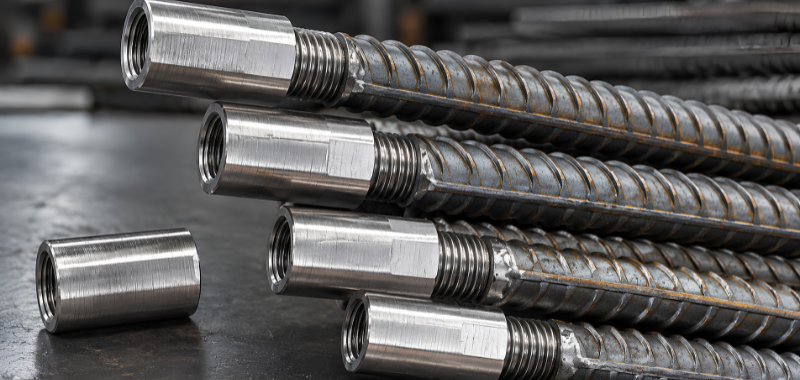
A rebar coupler is a mechanical connector designed to join two reinforcing bars and maintain continuity within the reinforcement system. Depending on the coupler design, the connection may use threading, crimping, welding, or other mechanical connection methods.
The primary purpose of a mechanical rebar coupler is to transfer forces between connected reinforcement bars while reducing the need for traditional overlapping reinforcement.
SPPLICETEK offers a range of mechanical splicing solutions, including Cold Forged Parallel Thread Couplers, H Type Couplers, Weldable Rebar Couplers, Stainless Steel Couplers, Terminator/Headed Bar Couplers, Reducer/Transition Couplers, and Crimping/Sleeve Couplers.
Why Are Rebar Couplers Used in Construction?
1. Reduce Reinforcement Congestion
One of the major challenges in reinforced concrete construction is congestion caused by overlapping reinforcement bars. When multiple rebars are lapped in the same area, the reinforcement arrangement can become crowded.
Rebar couplers provide an end-to-end connection, reducing the amount of overlapping steel required. This can create more available space around reinforcement and support better concrete placement and consolidation. Mechanical couplers are especially useful in heavily reinforced structural sections.
2. Reduce Steel Wastage
Traditional lap splicing requires additional reinforcement length because two bars need to overlap for a specified distance. On large construction projects involving thousands of reinforcement bars, this additional steel can become significant.
By connecting bars mechanically rather than overlapping them, a rebar coupler system can reduce unnecessary overlap and help optimize reinforcement consumption. This makes mechanical splicing particularly relevant for large infrastructure and high-volume construction projects.
3. Efficient Connection for Large-Diameter Rebars
As reinforcement bar diameter increases, conventional lap splices can require substantial overlap lengths. This can increase congestion and make reinforcement installation more difficult.
Mechanical couplers can provide a practical connection method for large-diameter reinforcement bars where traditional lapping may become difficult or inefficient.
4. Faster Reinforcement Installation
Construction schedules are often dependent on the speed at which reinforcement can be fabricated, positioned, and connected.
Depending on the selected coupler technology and project requirements, mechanical splicing can simplify reinforcement connections and reduce the work associated with preparing long lap joints. This can help contractors improve reinforcement installation efficiency and manage demanding project schedules.
5. Better Use of Available Space
Space can be limited in columns, beams, walls, foundations, tunnels, and other reinforced concrete structures.
Because a mechanical rebar coupler connects reinforcement bars end-to-end, it can be useful in locations where providing a conventional lap is difficult. Mechanical splicing is commonly considered for areas where reinforcement congestion or limited space makes lap splicing impractical.
6. Supports Structural Load Transfer
A properly selected and installed mechanical splice is designed to transfer forces between connected reinforcement bars. Depending on the coupler type and applicable project specifications, mechanical splices can be designed for tension, compression, or both.
Industry guidance recognizes mechanical splices as an alternative to lap splices, with different mechanical splice classifications based on their required performance.
For this reason, engineers should select rebar couplers according to the reinforcement grade, bar diameter, structural requirements, applicable standards, and project specifications.
7. Useful for Building & Infrastructure Projects
Large construction and infrastructure projects often involve extensive reinforcement and challenging construction conditions.
Rebar couplers can be used in applications such as:
Buildings
Bridges
Hydro Power Projects
Railway Infrastructure
Underground Metro
Metro Projects
Bullet Train Projects
Nuclear Power Plants
Airports
SPPLICETEK provides rebar coupler and mechanical splicing solutions for building and infrastructure projects with different reinforcement connection requirements.
Rebar Coupler vs. Traditional Lap Splicing
Both methods are used to connect reinforcement, but their installation principles are different.
Feature | Rebar Coupler | Traditional Lap Splicing |
Connection method | Mechanical connection | Overlapping reinforcement bars |
Steel overlap | Significantly reduced | Required |
Reinforcement congestion | Can be reduced | Can increase in lap zones |
Large-diameter bars | Suitable for many applications | Can require substantial lap length |
Space requirements | Compact connection | Requires overlap space |
Installation | Mechanical installation | Requires positioning and tying of overlapping bars |
Project suitability | Useful for complex and heavily reinforced structures | Common conventional method |
The appropriate connection method should always be determined by the structural design, applicable codes, project specifications, and qualified engineering professionals.
Types of Rebar Couplers
Different construction requirements call for different mechanical splicing solutions. SPPLICETEK offers rebar couplers designed for various reinforcement connection applications.
1. Cold Forged Parallel Thread Couplers (CFPTC)
Cold Forged Parallel Thread Couplers (CFPTC) include the following specialized coupling solutions:
Parallel Rebar H Type Coupler
Designed to connect reinforcement bars using a parallel threaded connection, providing a reliable mechanical splicing solution.
Weldable Rebar Coupler
Designed for applications where reinforcement bars need to be connected to structural steel components through welding.
Parallel Rebar S.S. Coupler
Manufactured using stainless steel and suitable for applications where corrosion resistance is an important consideration.
Terminator / Headed Bar Coupler
Designed for reinforcement anchoring and termination applications where specific development and anchorage requirements need to be addressed.
Reducers / Transition Coupler (H-Type Reducer)
Designed to connect reinforcement bars of different diameters, providing an effective transition between different rebar sizes.
2. Crimping / Sleeve Coupler
Crimping / Sleeve Coupler is a mechanical splicing solution designed to connect reinforcement bars using a sleeve-based connection system. It is suitable for construction applications requiring an efficient and practical method of joining reinforcement bars.
Where Can Rebar Couplers Be Used?
Rebar couplers are used across various building and infrastructure projects where reliable mechanical reinforcement connections are required. SPPLICETEK provides mechanical splicing solutions for the following applications:
1. Buildings
Rebar couplers can be used in building construction where reinforcement congestion, large-diameter bars, and limited working space can make conventional lap splicing challenging. Mechanical splicing helps create efficient reinforcement connections in structural components such as columns, beams, walls, and foundations.
2. Infrastructure
Bridge
Bridge structures require extensive reinforcement to withstand demanding structural loads. Rebar couplers can provide efficient mechanical connections for reinforcement in bridge construction and related structural components.
Hydro Power
Hydropower projects involve large concrete structures with significant reinforcement requirements. Mechanical rebar couplers can support efficient reinforcement connections in suitable structural applications.
Railway
Railway infrastructure requires durable and efficient reinforcement solutions across different structural elements. Rebar couplers can be used where mechanical reinforcement splicing is required.
Railway applications include:
Underground Metro – Mechanical rebar couplers can help manage reinforcement connections in underground metro structures where working space and reinforcement congestion can be challenging.
Metro – Rebar couplers can support efficient reinforcement connections in metro stations, elevated structures, and other metro infrastructure.
Bullet Trains – High-speed railway infrastructure requires precisely engineered structural systems. Mechanical splicing can be used for reinforcement connections in suitable structural applications.
Nuclear Power Plants
Nuclear power plant construction involves heavily reinforced concrete structures with demanding engineering and quality requirements. Suitable mechanical rebar couplers can be used where specified by the structural design and project requirements.
Airports
Airport infrastructure includes large structural elements requiring extensive reinforcement. Mechanical rebar couplers can provide efficient reinforcement connections for suitable airport construction applications.
How to Select the Right Rebar Coupler?
Choosing a rebar coupler should not be based only on bar diameter or price. Several technical factors should be considered:
- Rebar Diameter: Confirm that the coupler is compatible with the reinforcement bar size.
- Steel Grade: Check compatibility between the coupler and reinforcement steel grade.
- Connection Type: Determine whether parallel threading, welding, crimping, headed anchorage, or another system is required.
- Structural Loading: Consider the required tension and compression performance.
- Project Conditions: Evaluate accessibility, reinforcement congestion, working space, and installation conditions.
- Applicable Standards: Verify the relevant national, project-specific, and international requirements.
- Quality Assurance: Select couplers manufactured under controlled quality processes and supported by appropriate testing and documentation.
For critical structural applications, engineers and project teams should verify product suitability against the approved structural design and applicable standards.
Why Choose SPPLICETEK Rebar Couplers?
SPPLICETEK provides mechanical splicing solutions designed for demanding reinforcement applications. Its product range includes multiple types of rebar couplers for different bar configurations and construction requirements.
According to SPPLICETEK’s website, its rebar couplers are designed to connect TMT reinforcement bars end-to-end and are available for applications involving high-rise buildings, bridges, metro projects, tunnels, dams, power plants, and other infrastructure projects. The company also states that its manufacturing follows quality-control processes and lists ISO 9001 certification and compliance with IS 16172:2014 among its credentials.
The right mechanical splicing solution can help construction teams address reinforcement congestion, optimize steel usage, simplify reinforcement connections, and improve installation efficiency.
Frequently Asked Questions About Rebar Couplers
-
What is a rebar coupler?A rebar coupler is a mechanical connector used to join two reinforcement bars end-to-end. It provides continuity between reinforcement bars without requiring the same type of overlapping arrangement used in traditional lap splicing.
-
Why are rebar couplers used?Rebar couplers are used to connect reinforcement bars efficiently, particularly where reinforcement congestion, large bar diameters, limited space, or project-specific structural requirements make conventional lap splicing less practical.
-
Do rebar couplers reduce steel wastage?Mechanical couplers can reduce the additional reinforcement associated with overlapping bars because the bars are connected end-to-end. The actual steel savings depend on the structural design, bar arrangement, coupler type, and project conditions.
-
Are rebar couplers suitable for large infrastructure projects?Yes. Mechanical splicing systems are used in various infrastructure applications, including bridges, metro projects, tunnels, dams, railways, power plants, and high-rise structures, subject to structural design and applicable requirements.
-
What types of rebar couplers are available?Common types include parallel thread couplers, cold forged couplers, H Type couplers, weldable couplers, stainless steel couplers, terminator or headed bar couplers, reducer/transition couplers, and crimping/sleeve couplers.
-
How do I select the right mechanical rebar coupler?Selection should consider reinforcement diameter and grade, required load performance, connection type, installation conditions, applicable standards, and the structural engineer's specifications.
Conclusion
As construction projects become taller, larger, and more structurally complex, efficient reinforcement connection systems are increasingly important. Rebar couplers offer a mechanical alternative to conventional lap splicing and can help reduce reinforcement congestion, optimize steel usage, simplify connections, and improve installation efficiency.
From high-rise buildings and bridges to metro systems, tunnels, dams, railway projects, and power plants, mechanical splicing can provide a practical reinforcement connection solution when correctly specified and installed.
If you are planning a construction or infrastructure project and need a suitable rebar coupler, explore SPPLICETEK’s range of mechanical splicing systems and select the solution according to your project requirements.